
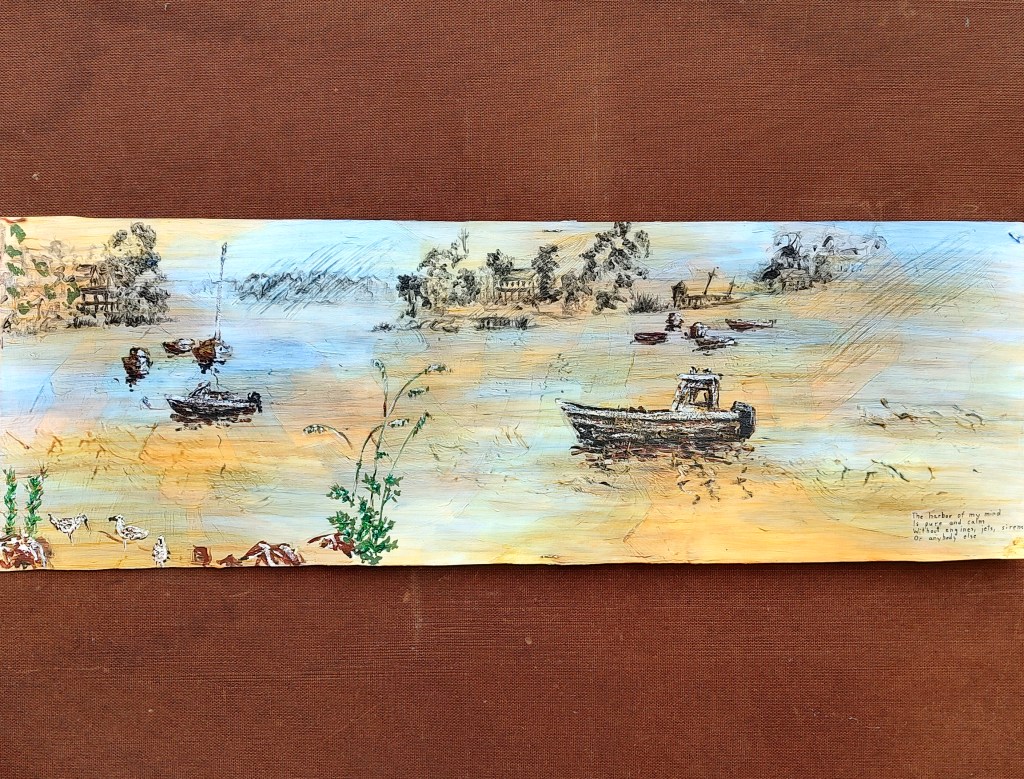
Acrylic on Canvas Paper, 2000, 12×36
The harbor of my mind / is pure and calm / without engines, jets, sirens / or anybody else.
All paintings at: https://sites.google.com/view/cabinetofvanities
Acrylic on Canvas Paper, 2000, 12×36
The harbor of my mind / is pure and calm / without engines, jets, sirens / or anybody else.
All paintings at: https://sites.google.com/view/cabinetofvanities

There have been many answers to the ancient question “what is the meaning and purpose of life”. I am sure, unless you are a dedicated fanatic, that you can come up with many. Possibly the silliest – currently ruling American society – is that the answer is “work”.
Supposedly that can be traced to the country’s “Protestant ethic” heritage, but as a modest student of history I know that for masses of people – and the common attitude – this was rarely so. There was religion, morality, social progress, and a lot of other noble stuff, as well as less articulated hedonism, happiness, and just getting by.
But today the Orwellian elites have not only seized control of the means of production, but also dictate mythology. Now “work” as they define it is the only virtue. Lack of such work is evil and should be wiped out. Even mindless sanctified work is SO much better than meditation or playing a flute in a tree (unless of course you don’t much want to meditate or toot that flute – work is defined as “forced to do something you don’t want to do”.)
So, madly, we are driven to consider exercise, happiness, consumption, existence itself as meaningless useless wastes of time unless they involve “work”. “Work”, anyway as defined by the myth makers, which somehow always involves coercion and money to yield a spiritual result.
I suspect in the long run alternative answers might be better.
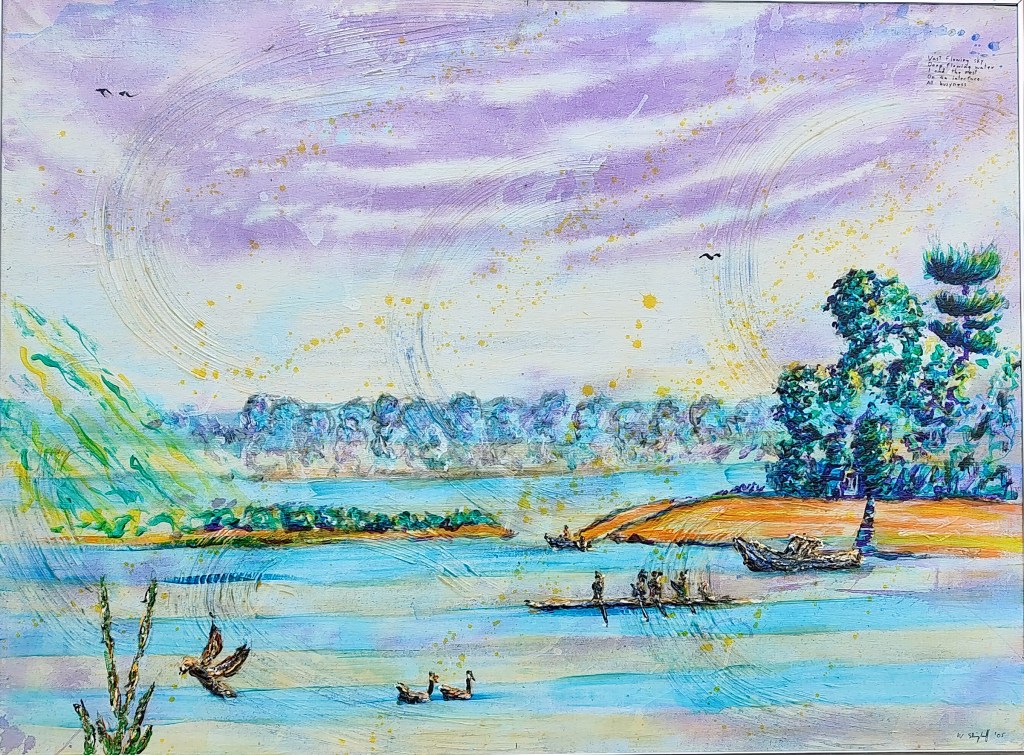
Acrylic on Canvas, 2005, 30×40
Vast flowing sky / deep flowing water / I and the rest on an interface / all busyness
All paintings at: https://sites.google.com/view/cabinetofvanities

Joan has a cousin who attends “Bible study” each week. It helps her feel better. Many of us have such literary touchstones. I reread a bit of Terry Pratchett before bed. For others it has been Shakespeare, or Austin, or even trashy novels.
I’ve been aware since young adulthood of the various odd forms of unlocking intuitions and centering the self. I’ve watched tarot cards perform magic. I’m sure the same was true in ancient times when divining meaning from flights of birds or sacrificial entrails. Intuitive truth is rarely found with logical analysis.
The only issue I have with “Bible study” has nothing to do with whether it is valid for those who do it. I’m sure, like other intuitive focus activities, it works well. And the Bible certainly has enough contradictions, comments, admonitions, fables, and ideas to satisfy any need. Plus a large dollop of historic belief, which brightens its aura.
All that bothers me is a tendency of Bible users to try to rule me with their divinations. No tarot reader ever tried to do so, nor any reader of entrails. I respect the methodology of the users, but only for the users.
Somehow, any holy writ study often leads to a literal “holier than thou” aggression. It is not enough to merely center an individual _ such folks often preach. I reject that.
In the right circumstances, for the right user, any mantra or meditation will work well. That doesn’t mean it should be adapted by everyone nor forced on society.

A recent reference to the religious meaning of “mortification” – giving up physical delights which are seen as sinful – tickled my fancy. I wonder if society today does not do a lot of the same things in relation to “scientific” fads and rumors. Mortification is basically an extreme extension of common sense rejection of total hedonism.
We all realize that if we go too crazy indulging every momentary desire, we will regret it. Some cults and individuals have extended that to believe ALL momentary delight will only lead to bad outcomes – rejection by a god, loss of eternal life, karmic judgment, whatever. So monks sat on pillars in a desert, or purposely inflicted pain on themselves to become more holy.
I have friends and read stories which indicate the same thinking is beginning to permeate the culture. Folks are avoiding ultra processed food, sugar, sun exposure, any given thing at any given day depending on the latest Internet “revelation”. All to feel better in the long run, sort out current problems, live longer and healthier.
Moderating hedonism is, of course, always a good thing. Being aware of lifestyle and its consequences is useful. But rejecting pleasure simply because it is pleasure – and therefore “evil” – is pretty stupid.
If we don’t enjoy our lives – a lot! – we are missing the whole point. That monk in the desert will refuse clothing. Some of my friends will refuse ice cream. I tend to laugh at each of them and think we will all end up in similar condition in another hundred years.
And I’ve also lived long enough to understand fads and that what is “good” for us today may be really “bad”. And vice versa.
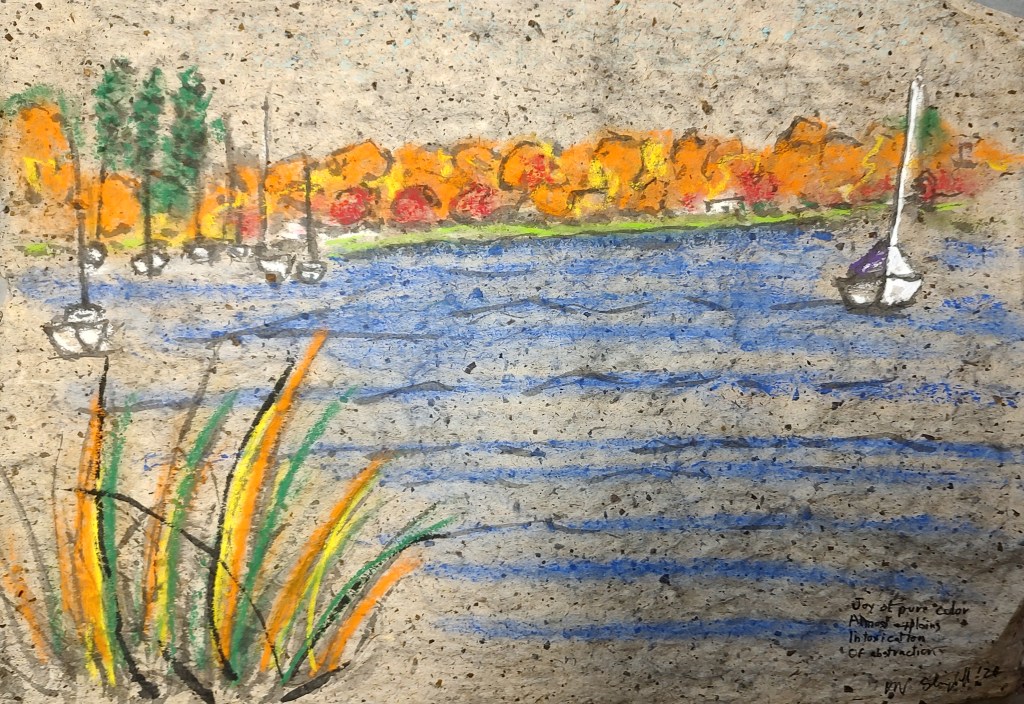
Pastel and Ink on Mulberry Paper , 2026, 11×15
Joy of pure color / Almost explains / Intoxication / Of abstraction
All paintings at: https://sites.google.com/view/cabinetofvanities

There are three widely desperate dictionary meanings to the word “mortification”. Extreme social embarrassment, religious concentration on spiritual over bodily matters, and medical tissues dying. I mix them all and will use mortification as an alternative to “aging” which has become far too overloaded with connotations. Especially extreme aging after 80 or so.
Mortification in the eldest elders fits the definition pretty well. There is shame at the loss of abilities, health, and social meaning. There is a need to concentrate on almost anything except the physical, as mind and body noticeably deteriorate, often rapidly. And there is the hard realization that creeping death of parts will eventually, not too distantly, become death of all.
I especially, like many of my peers, grasp at the spiritual aspect. It is the simplest way to avoid shame. It is relatively easy to not focus on “sinful” pleasures of the flesh. And it is simple acceptance that death is always part of life.
Many advanced elders find their own ways to spiritual calm, whatever works. The problem with any mortification, naturally, is how much, how far, how soon. No need to mortify too quickly.
Accepting death and irrelevance is all very well, but moments are still infinite and enchanted. The final end after all, will show up as it will, whether we accept it or not.
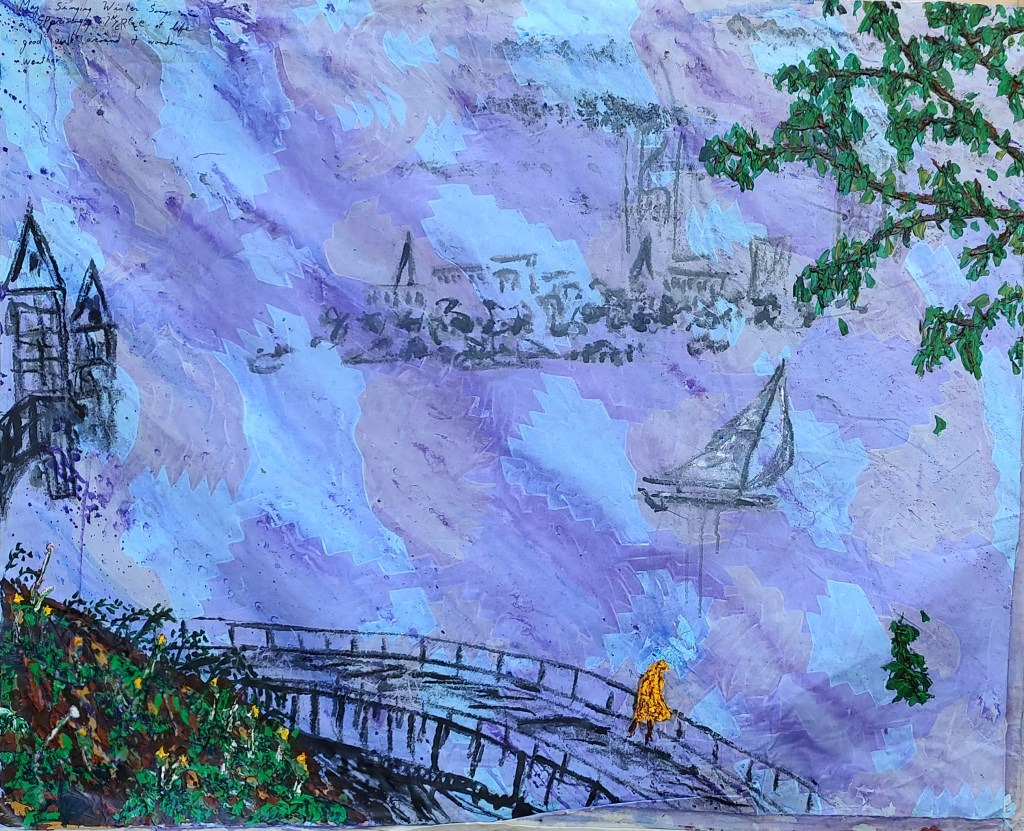
Acrylic on Canvas, 1976, 36×44
May singing winter songs / spring interface of life / good walk around and wonder / weather
All paintings at: https://sites.google.com/view/cabinetofvanities

Louis Carroll had Humpty Dumpty state “words mean what I want them to mean, neither more nor less”. Orwell expanded this into the political realm (“war is peace”) following the Nazis (“work is freedom”). We are living in a time when the meaning of words is as fluid as water.
On the one hand are the straight reversals. “I am honest” claims the dishonest politician. “I’m not a crook” the crook tells us earnestly. And – worse than that _ what do we mean by “honest” or “crook?” And by extension and implication isn’t everyone?
Then there are the all-encompassing labels, when simple values or statements are branded as signals for so much more – usually evil. These are at least our traditional – “traitors”, “communists”, ” “woke”. By making any small idea (“police should be less brutal”) into a monolithic conspiracy including all ideas that the speaker does not like, conversation becomes impossible.
Obviously, when everyone from rulers to influencers to your mother-in-law, neighbor, and children can make any words mean whatever they want, communication cannot happen. Language has been a glory of our species.
In the old days, different languages sounded quite distinct. Now they all sound the same but are incomprehensible except to other members of your tribe.
We all know what happened to Humpty Dumpty.

Any society must do two big things: protect itself from other societies, and maintain internal order. Even the most rabid libertarian agrees there must be a military and an internal police force with systems to protect property, secure persons, and enforce contracts. That means bureaucracies that must be paid.
How to pay has varied tremendously. Small tribes were based on family obligation. Agricultural civilizations used payment in kind. Many empires simply looted. And, of course, there were taxes (for the military king) and tithes (for the social service priests).
After the industrial revolution, things have become very complicated. How to pay for necessary bureaucracy (and what is truly necessary to maintain that society) is uncharted territory in current civilizations. Everyone hates taxes and fees unless they fall on someone else. Hidden taxes and fees are hard to enforce and rarely bring in enough. Nobody is quite sure how to tax capital to retain meritocracy and production.
Two other methods have been tried. One is to simply let rulers buy their way to power and then loot and extort to get even richer. It worked for the Romans and it’s close to the democratic election system today (with elections bankrolled by corporations and special interests).
The other is donations as in religious tithes or today’s non profit gifts or internet pleas.
Purchase of power inevitably becomes unbearably corrupt and destroys the social fabric. Donations tend to clump into smaller and smaller cliques (such as immediate family) which also shatters society.
Perhaps there is a solution out there somewhere, or maybe simple evolution will provide a working methodology. It’s worked so far.

